
What negative balance protection is
Negative balance protection means a retail client cannot lose more than the money in their trading account. If a position gaps straight through your stop and past your balance, the broker resets the account to zero and absorbs the shortfall at no cost to you. It is mandatory for every ASIC-regulated broker's retail clients under the product intervention order, so it is not a feature you shop for. What you should shop for is the situations that remove it.
Most pages on this topic are broker FAQs that present negative balance protection as a perk. It is not a perk. It is a floor under a retail account that every licensed broker must provide. The useful questions are narrower: when does the floor disappear, what fires before it, and which extra tools sit on top of it.
The ASIC mandate
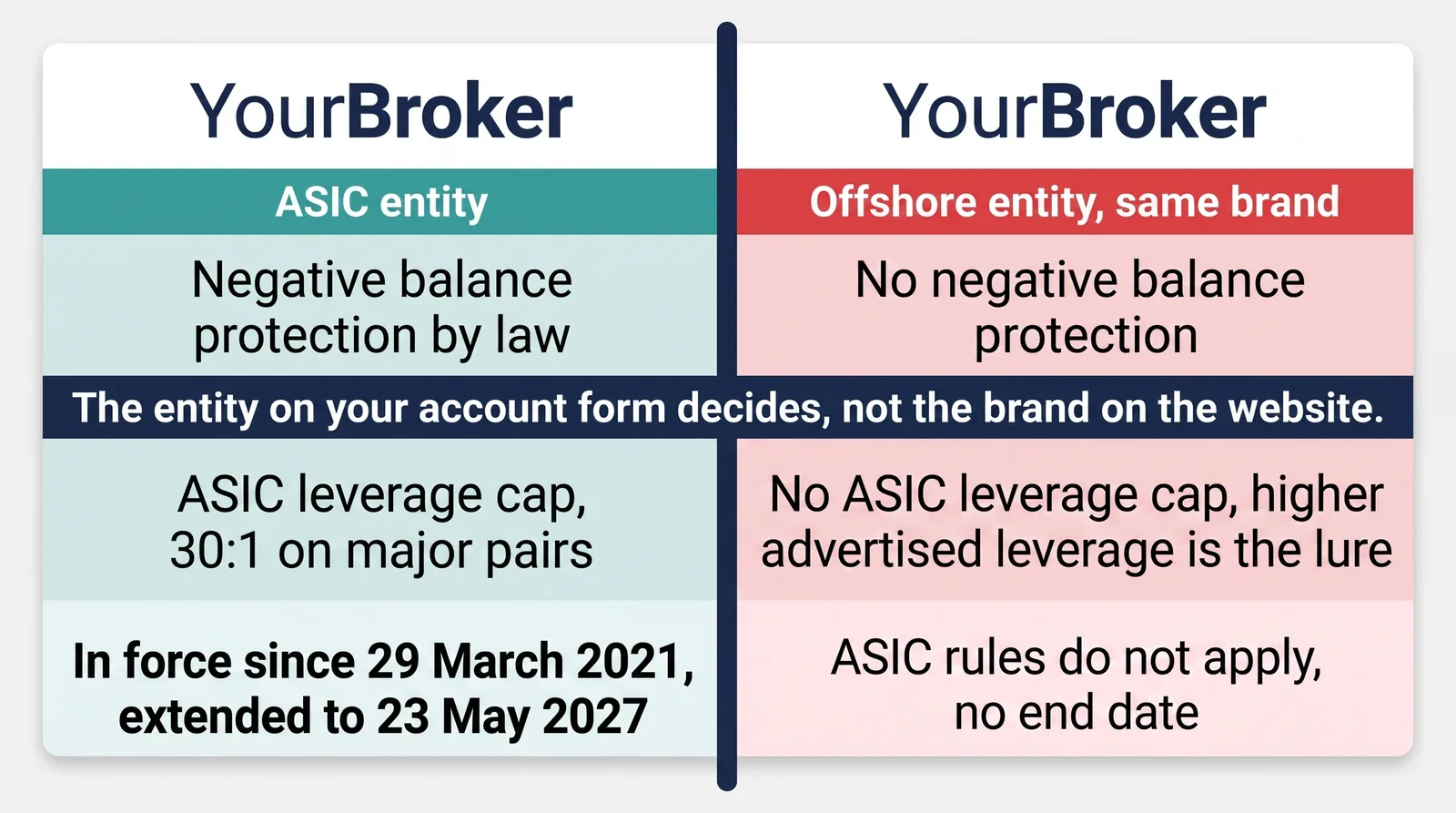
Negative balance protection is one of the retail conditions imposed by ASIC’s product intervention order, in force since 29 March 2021 and extended to 23 May 2027. Any firm issuing CFDs or margin forex to retail clients in Australia must apply it. That is why a broker-by-broker “does it have NBP” table is close to meaningless for retail accounts: the answer is yes at every ASIC broker, by law.
Retail-only: the scope that actually matters
The protection attaches to your client classification, not to the broker. Retail clients get it. Wholesale and professional clients do not. This matters because the wholesale route is marketed as an upgrade: qualify as wholesale and your leverage can rise from 30:1 to as much as 500:1. What the marketing tends to underplay is that the same reclassification removes negative balance protection. The trader running 500:1 is the one most likely to gap past zero, and is precisely the trader who has given up the protection against it. Treat wholesale status as a removal of protections in exchange for leverage, never as a simple upgrade. We cover the eligibility test and the full trade-off on the high-leverage brokers page.
Margin close-out fires first
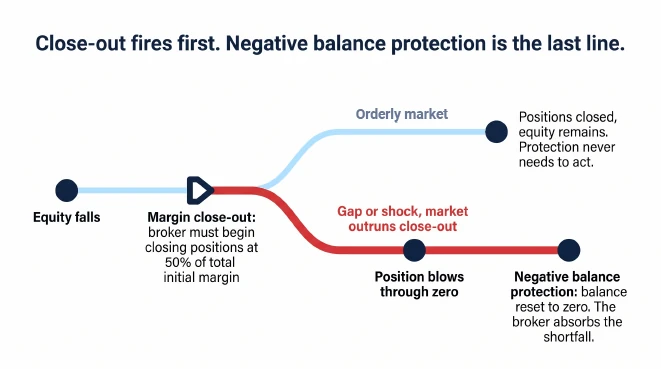
Negative balance protection is the last line, not the first. Before it, the margin close-out rule requires the broker to begin closing your positions once account equity falls to 50% of the total initial margin across all open trades. In an orderly market, close-out ends the position while there is still equity left, and negative balance protection never needs to act. It only matters when the market moves faster than close-out can, a weekend gap or a central-bank shock, and the position blows through zero before it can be closed. The mechanics of close-out are covered on our margin page.
Negative balance protection at the ASIC brokers, compared
Because the protection is mandatory, the table below is not a “who has it” list. It shows what genuinely differs: the extra risk tools each broker layers on top, and the reminder that the wholesale route removes the retail protection everywhere.
| Broker | Negative balance protection (retail) | Complementary risk tool | Wholesale route removes it |
|---|---|---|---|
| Pepperstone | Yes (mandatory) | Standard stop and limit orders | Yes |
| IC Markets | Yes (mandatory) | Standard stop and limit orders | Yes |
| CMC Markets | Yes (mandatory) | Guaranteed stop-loss orders (fee applies) | Yes |
| IG | Yes (mandatory) | Guaranteed stop-loss orders (fee applies) | Yes |
| Plus500 | Yes (mandatory) | Guaranteed stop-loss orders | Yes |
| easyMarkets | Yes (mandatory) | dealCancellation and guaranteed stops | Yes |
| AvaTrade | Yes (mandatory) | AvaProtect loss cover (fee applies) | Yes |
| Focus Markets | Yes (PDS clause 6.3) | None offered | Not published |








Where a guaranteed stop-loss order is offered, it caps the exit price even through a gap, for a fee, which is a different and more active protection than the balance floor. Product availability and fees change, so confirm the current terms on each broker’s own disclosure before relying on a specific tool.
Two rows in that table are worth reading closely, because they show how much the detail varies underneath a rule that sounds uniform.
Focus Markets is the only broker here selling no complementary risk tool at all. Its Australian FAQ answers the question directly: “You are responsible for monitoring your trades. We do not offer guaranteed stop-losses.” Everything above it offers something, whether that is a guaranteed stop, dealCancellation or purchased loss cover. Focus Markets gives you the mandatory floor and standard stops, and nothing you can pay extra for.
Its protection clause also reads differently. Most disclosure documents apply the balance floor per account. The Focus Markets PDS (June 2025) writes clause 6.3 with a cross-account net-off provision, which means the protection is assessed across your accounts with that broker rather than ring-fenced to the one that gapped. If you hold more than one account with a single broker, that clause is worth reading before you assume each is walled off from the others.
The last column is a gap rather than a finding. Focus Markets publishes no wholesale offer on its Australian site: no leverage tiers, no eligibility test and no issuing entity. Every other broker in the table documents a wholesale route that removes negative balance protection, so a reader can see what they would be giving up. Here you would have to ask.
Onshore versus offshore: no ASIC entity, no ASIC protection
Negative balance protection follows the ASIC licence. Open an account with a broker’s Australian AFSL holder and it applies. Open one with the same brand’s offshore entity, often the entity that advertises higher leverage, and it does not, because ASIC’s rules do not reach that account. Before funding, confirm on ASIC’s register that your account is with the Australian entity, not an overseas affiliate. Our safest forex brokers guide ranks the ASIC entities on exactly these trust signals.
Tools that go beyond the balance floor
Negative balance protection stops your account going negative. It does nothing to improve your exit price. Three tool types address that gap, at a cost:
- Guaranteed stop-loss orders (GSLOs). Offered by CMC, IG and Plus500 among others, a GSLO guarantees your exit price even if the market gaps through it, for a premium.
- dealCancellation. easyMarkets lets you undo a losing trade within a set window for a fee, a time-boxed insurance on a single position.
- AvaProtect. AvaTrade sells a period of loss cover on a position for a fee, refunding losses over that window.
None of these makes trading safe. They are priced risk transfers for specific situations, and each carries its own cost that eats into returns.
If a broker does not honour it
Because the protection is a licence condition, a broker declining to apply it to a retail account is a conduct issue, not a trading outcome. Raise it in writing with the broker first. If unresolved, escalate to the Australian Financial Complaints Authority, which is free for consumers and can issue a determination the broker is bound to follow. Moneysmart’s CFD guidance is a useful reference on your rights before you get to that point.
Why the rule exists: the 2015 franc shock
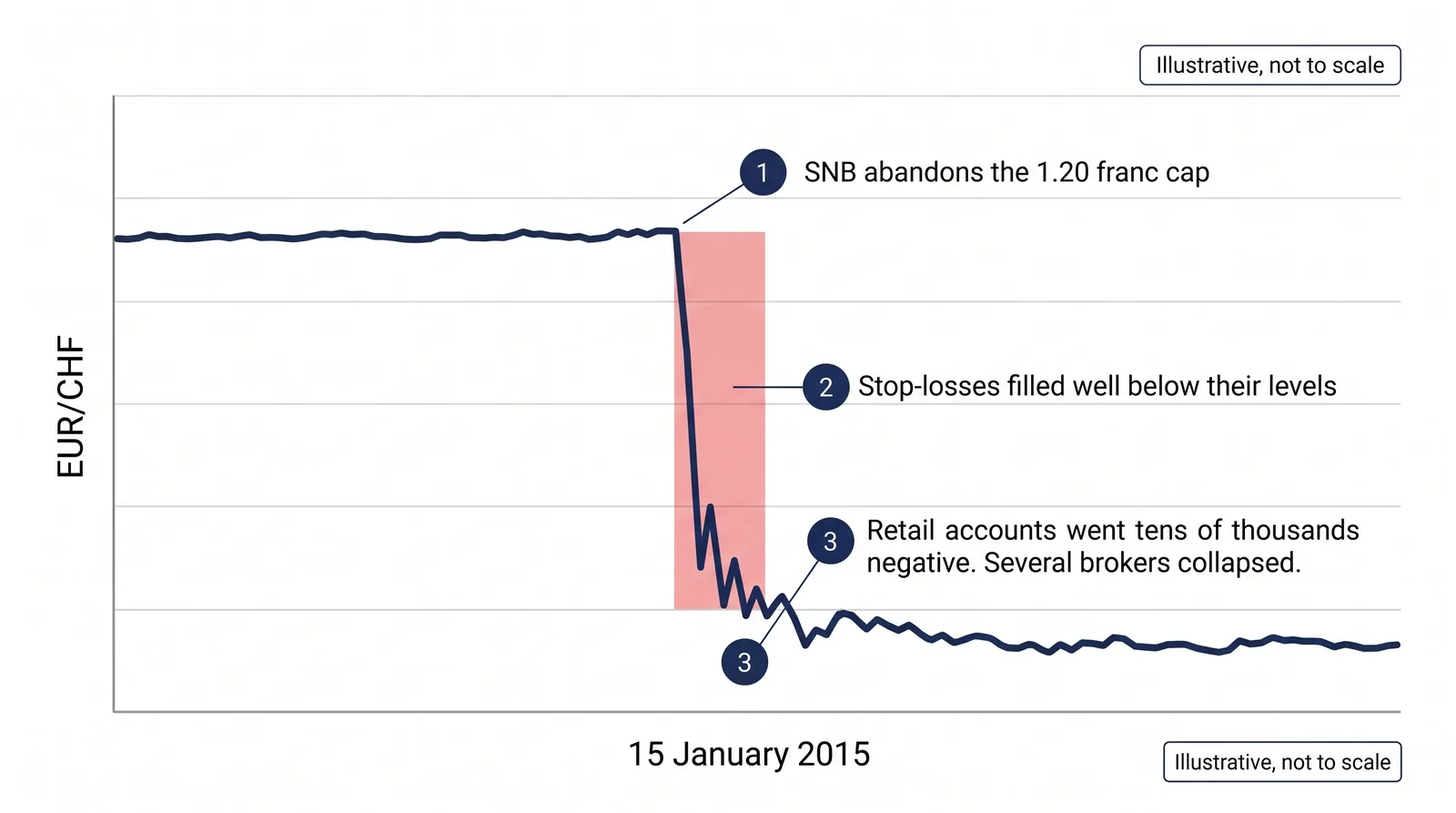
Negative balance protection is a direct response to real losses. On 15 January 2015 the Swiss National Bank abandoned its franc cap, and EUR/CHF moved so far and so fast that stop-losses filled well below their levels. Retail traders around the world woke to accounts tens of thousands of dollars in the red, owing money they never deposited. Several brokers collapsed. The retail protections ASIC later mandated, close-out and the negative balance floor, exist so that an Australian retail client cannot be handed that bill again.
FAQs
Is negative balance protection mandatory in Australia?
Can I lose more than my deposit trading forex in Australia?
Does negative balance protection mean forex trading is safe?
Who does not get negative balance protection?
What happens if a broker does not honour negative balance protection?
Related pages
About the author

Justin co-founded CompareForexBrokers in 2014 and has traded forex since 1998. Based in Melbourne, he has tested every ASIC-regulated broker on this site personally and has written for Forbes, Kiplinger, Finance Magnates, the Australian Financial Review and The Age. He holds a Bachelor of Commerce (Honours) and a Master of Marketing from Monash University. Justin is the co-founder and CEO of CompareForexBrokers.