



Trading CFDs and forex carries a high level of risk and may not be suitable for all investors. Read the relevant Product Disclosure Statement before opening an account.
Our verdict on Fortrade
Fortrade is a coverage entry rather than a recommendation, and the score says so. Fort Securities Australia Pty. Ltd. holds AFSL 493520 with a market-making authorisation, segregates client money under the Australian client money rules and provides negative balance protection to retail clients. Those are real protections. What sits against them is the price: the broker advertises 2.5 pips on EUR/USD, and on our own reading of all 21 major pairs the live figure was wider than the advertised one on 16 of them.
Australians get two things here that no offshore review of this broker mentions. All 21 major pairs run at 30:1, where a British client of the same brand gets 20:1 on seven of them, because ASIC counts AUD pairs as majors and the FCA does not. Twelve crypto CFDs sit at 2:1 on the Australian menu, and British retail clients cannot touch them at all. Both are regulator differences rather than anything Fortrade chose.
The gaps are disclosure gaps more than product gaps. No margin close-out level appears anywhere in the platform. The withdrawal screen shows no fee, no minimum and no processing time, with or without a method selected. And the dormancy trigger on Fortrade's own website contradicts the dormancy trigger in its own Product Disclosure Statement by a factor of two. Servicing is the other weak point: a modal asks every six weeks for consent to be phoned with offers to trade CFDs, and our own account was rung from a United Kingdom number late at night Australian time, twice, within hours of the deposit going in. A trader who wants measured pricing, a platform choice and a local desk is better served by the brokers named at the end of this review.
Pros
- ASIC AFSL 493520, held by Fort Securities Australia Pty. Ltd. since 6 February 2019, with client money segregated under the Australian client money rules and negative balance protection for retail clients
- No commission on any instrument, on any account, per the Australian Product Disclosure Statement dated 10 June 2025
- All 21 major currency pairs at 30:1, where a British client of the same brand gets 20:1 on seven of them
- Twelve crypto CFDs at the ASIC 2:1 cap, an asset class the brand's British entity cannot offer retail clients at all
- BPAY and PayPal both available for funding, and the deposit screen states its A$200 minimum in Australian dollars rather than in a foreign currency
Cons
- EUR/USD is advertised at 2.5 pips, the widest headline figure on this site, and the currency table carrying it states it was last updated 6 March 2026
- Nothing in the platform states a margin close-out level, the withdrawal screen shows no fee, no minimum and no processing time, and the two published dormancy triggers contradict each other by a factor of two
- After a A$200 PayPal deposit was submitted, a caller from a United Kingdom number rang late at night Australian time and asked for proof of the bank transfer behind it, a demand unique among the accounts this site has opened since 2014
- MetaTrader is advertised on no Fortrade website, app listing or platform page in any market, so a trader cannot know before funding that MT4 exists
- A modal on login asks for consent to be phoned about offers to trade CFDs, on a stated six-week cycle, and offers a consent button with no decline button beside it
Fortrade score breakdown
2.5/5 · Fair
The overall CFB Score comes from the full methodology, more than 100 data points per broker. The category ratings summarise each area and do not reconcile by simple average.
How is our rating calculated?Fortrade Australia at a glance: 17 key facts
The table below sets out the Australian entity, its licence, its pricing model and the platform position, all read from Fortrade’s own Australian documentation and from a real Australian dollar account on 12 and 13 August 2026.
| Item | Detail |
|---|---|
| Australian regulator | ASIC, AFSL 493520, status CURRENT, commenced 6 February 2019 |
| Australian entity | Fort Securities Australia Pty. Ltd., ABN 33 614 683 831, ACN 614 683 831 |
| Registered address | Level 5, 20 Bond Street, Sydney NSW 2000 |
| Licence authorisations | General advice, dealing by issue and on behalf of another, and making a market, in derivatives and foreign exchange contracts, to retail and wholesale clients |
| Trading platforms | Fortrader web and mobile. MT4 credentials issue on funding and are advertised nowhere |
| Minimum deposit | A$200, denominated in Australian dollars |
| Trading commission | None, on any instrument |
| Advertised EUR/USD spread | 2.5 pips, from a table stating it was last updated 6 March 2026 |
| CFD instruments (AU) | 329 across eight asset classes |
| Major currency pairs | 21, all at 30:1 |
| Crypto CFDs | 12, at 2:1, with Ether Futures at 1:1 |
| Australian share CFDs | 19, including CBA, ANZ, CSL, Macquarie, Coles and Aristocrat |
| Deposit methods | Credit card, PayPal, BPAY, wire transfer |
| Withdrawal methods | Credit and debit card, wire transfer, e-wallet, PayPal |
| Margin close-out | Not disclosed in the platform |
| Negative balance protection | Yes, for retail clients |
| AFCA member | Yes |
The platform row and the margin close-out row are negative findings, not data, and each gets its own section below.
Fortrade fees: no commission, and the spread carries everything
Fortrade charges no commission on any instrument, on any account, per section 5 of the Australian Product Disclosure Statement dated 10 June 2025. Every cost a client pays sits inside the spread, which puts more weight on the spread figure here than at a broker running a commission-based raw account alongside.
The advertised figures come from the Currency CFDs table on the Australian trading conditions page, and that table carries its own staleness notice: it states it was last updated on 6 March 2026. Five months is a long time for a pricing table, and the figure at the top of it is the widest EUR/USD headline on this site.
| Instrument | Advertised spread | Night-spread value in the payload | Carries the (*6) marker |
|---|---|---|---|
| EUR/USD | 2.5 pips | None | Yes |
| GBP/USD | 3 pips | 8 | Yes |
| USD/JPY | 2 pips | 8 | Yes |
| GOLD | US$0.80 | min US$1.1 | Yes |
| Crude Oil (CL) | US$0.05 | min US$0.07 | Yes |
| Silver | US$0.06 | min US$0.49 | No |
| GBP/CHF | 2.5 pips | 200, in a 21:55 to 22:55 window | No |
| EUR/CHF | 2.3 pips | 70, in a 21:55 to 22:55 window | No |
What we read on a live Australian account
A real Australian dollar account was opened and verified from Australia on 12 August 2026, with a A$200 PayPal deposit submitted the same day, and all 21 major currency pairs were read from it in one pass at 18:54 to 18:56 AEST. That is one dated observation on one account at one moment, not a sample, and nothing below is offered as a typical or average spread.
Across the 21 pairs, 16 were wider live than the advertised table, 3 were tighter and 2 matched. The five in the capture published below are the ones a reader can check against the artefact.
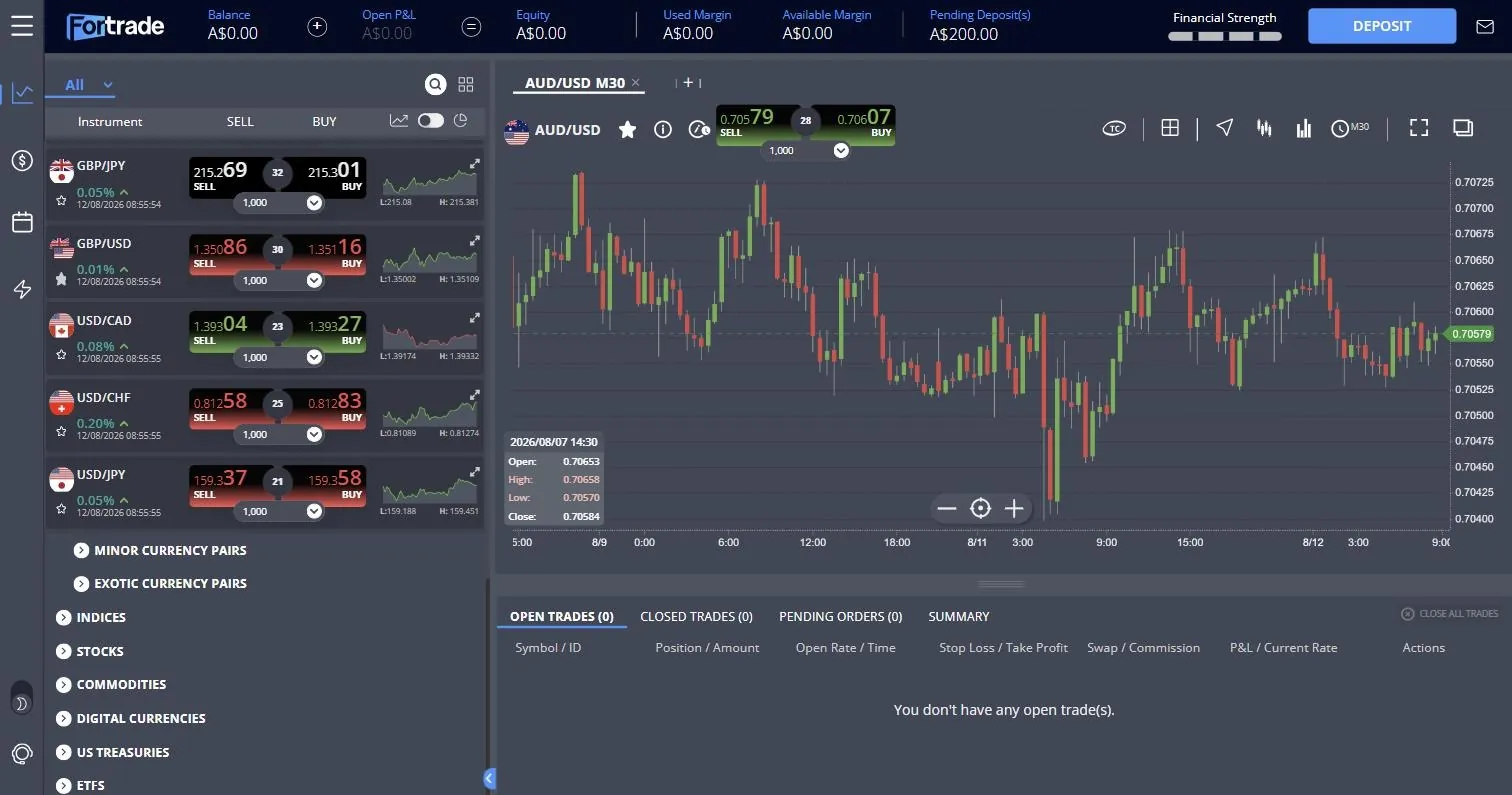
| Pair | Advertised | Read on the account, 18:54 to 18:56 AEST |
|---|---|---|
| GBP/JPY | 2 pips | 3.2 pips |
| GBP/USD | 3 pips | 3.0 pips |
| USD/CAD | 1.8 pips | 2.3 pips |
| USD/CHF | 2 pips | 2.5 pips |
| USD/JPY | 2 pips | 2.1 pips |
AUD/USD is the interesting exception. It advertises 4 pips and read 2.8 on the account, and that single pair is the one an Australian is most likely to check, which makes it the least representative sample anyone could pick. The advertised AUD/USD figure of 4 was re-read on the live page the same day and had not moved, so a stale table does not explain the pattern in either direction.
The night spread that lands in Australian business hours
Footnote 6 on Fortrade’s Australian trading conditions page reads, in full: “This currency pair has a night spread from 20:55 to 06:00 GMT.” Australia is GMT plus 10, so that window is 06:55 to 16:00 AEST. The hours Fortrade calls night are the Australian working day.
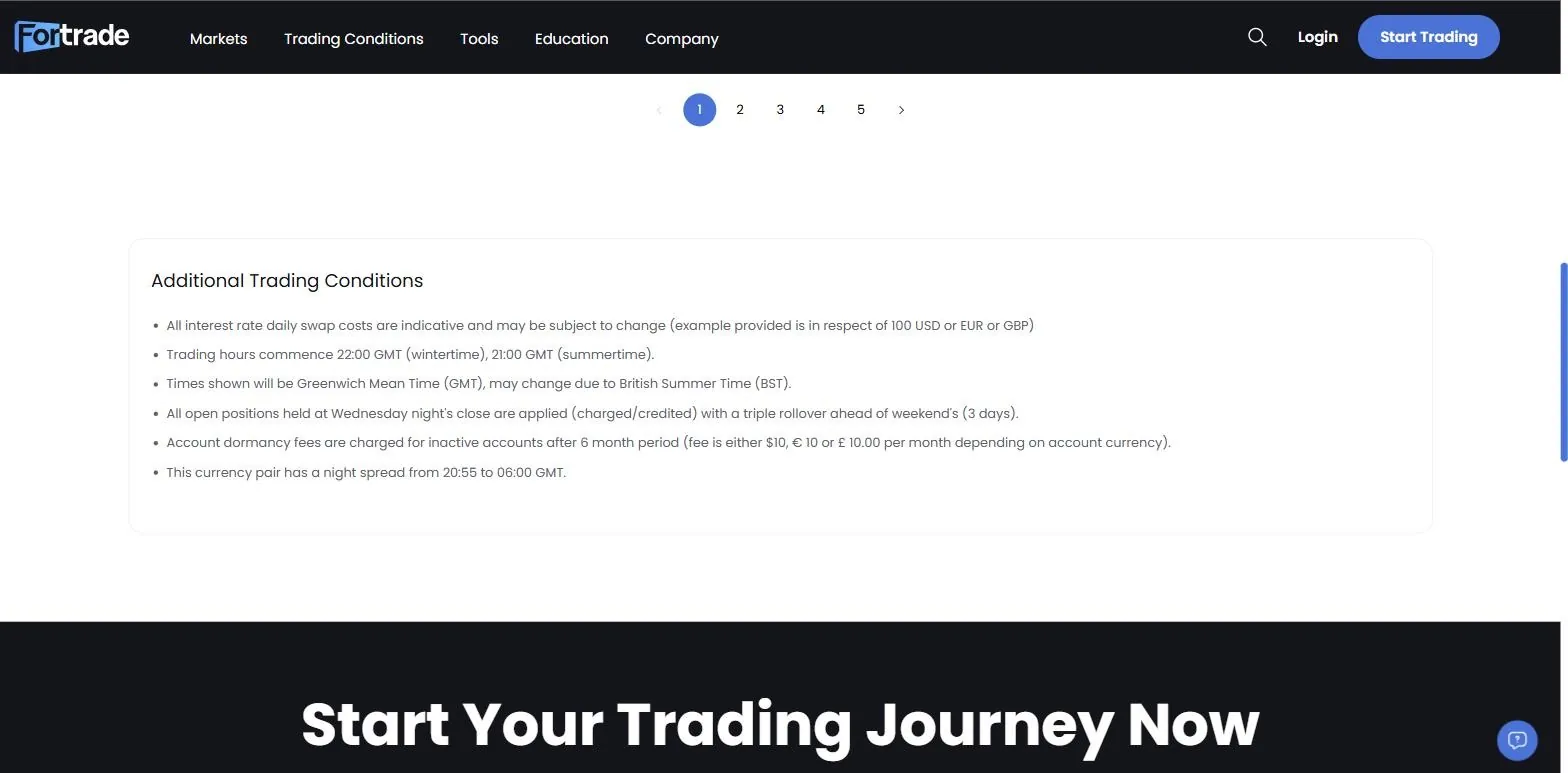
Five instruments carry the (*6) marker: EUR/USD, GBP/USD, USD/JPY, GOLD and Crude Oil. The marker and the underlying data disagree in both directions, and that changes what a reader can safely conclude. GBP/USD and USD/JPY both carry the marker and a night value of 8 against advertised figures of 3 and 2. EUR/USD carries the marker with no night value at all. Silver, GBP/CHF, EUR/CHF and several other pairs carry a night value with no marker, and those entries specify a one-hour 21:55 to 22:55 window, which is a different mechanism from footnote 6 and should not be read as the same thing.
What the window actually looks like
Everything above is what Fortrade publishes. On 13 August 2026 we read all five marked instruments off the real Australian dollar account inside the window, three times: at 09:52, 10:30 and 10:46 AEST, which the platform clock showed as 23:52, 00:30 and 00:46 GMT. All three sit well inside footnote 6’s 20:55 to 06:00 window. The readings were consistent across all three.
| Instrument | Advertised | Night value Fortrade publishes | Read inside the window |
|---|---|---|---|
| GOLD | US$0.80 | min US$1.10 | US$1.10 |
| Crude Oil (CL) | US$0.05 | min US$0.07 | US$0.07 |
| GBP/USD | 3 pips | 8 | 3.0 pips |
| USD/JPY | 2 pips | 8 | 2.1 pips |
| EUR/USD | 2.5 pips | none published | 2.5 pips |
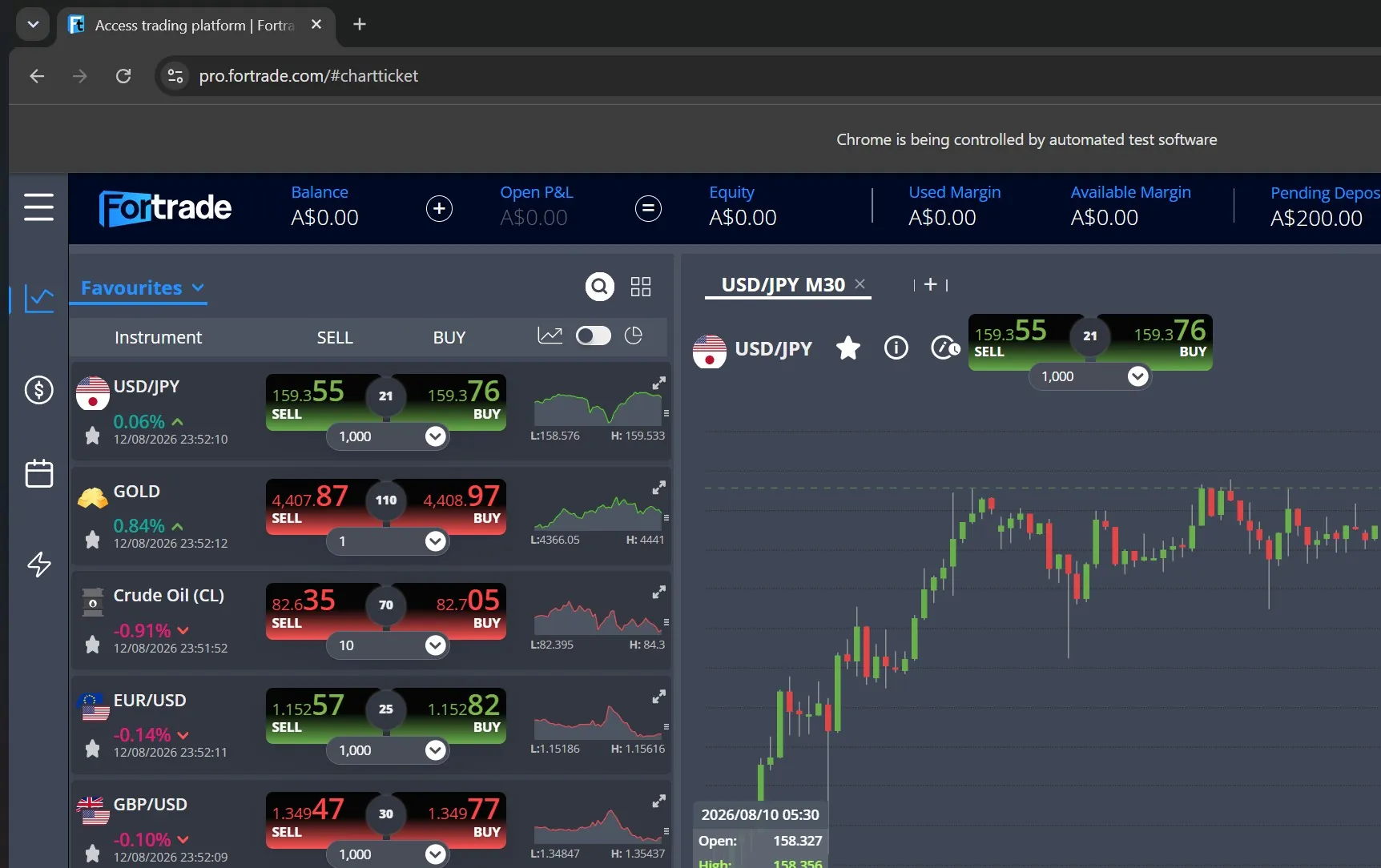
So the night spread is real, and it lands on the wrong half of the list.
Gold and crude oil both widened, and both landed on exactly the figure Fortrade publishes for them. The gold spread went from an advertised US$0.80 to US$1.10, the published minimum to the cent, and crude oil from US$0.05 to US$0.07, again the minimum exactly. We have a control on the gold reading: at 08:56 GMT on 12 August, outside the window, the same account showed gold at US$0.80.
The three currency pairs did not move. GBP/USD is advertised at 3 pips and carries a published night value of 8; it read 3.0. USD/JPY is advertised at 2 against a published night value of 8; it read 2.1. EUR/USD carries the marker with no night value published at all, and it read its advertised 2.5.
Read footnote 6 again with that in hand. It says “This currency pair has a night spread”, and the currency pairs are precisely where no night spread appeared, while the two instruments that are not currency pairs widened to the figure beside them. On the evidence of this account, the marker means something on gold and crude oil and did not mean anything on the three currencies during the hours we watched.
The reading reverses when the window closes. At 19:00 AEST the same day, which is 09:00 GMT and outside the window, the same five instruments were read again on the same account: gold back to US$0.80, crude oil back to US$0.05, and the three currency pairs unmoved at 2.5, 3.0 and 2.1. Gold therefore ran 0.80 outside the window, 1.10 inside it, and 0.80 outside it again, across a single day.
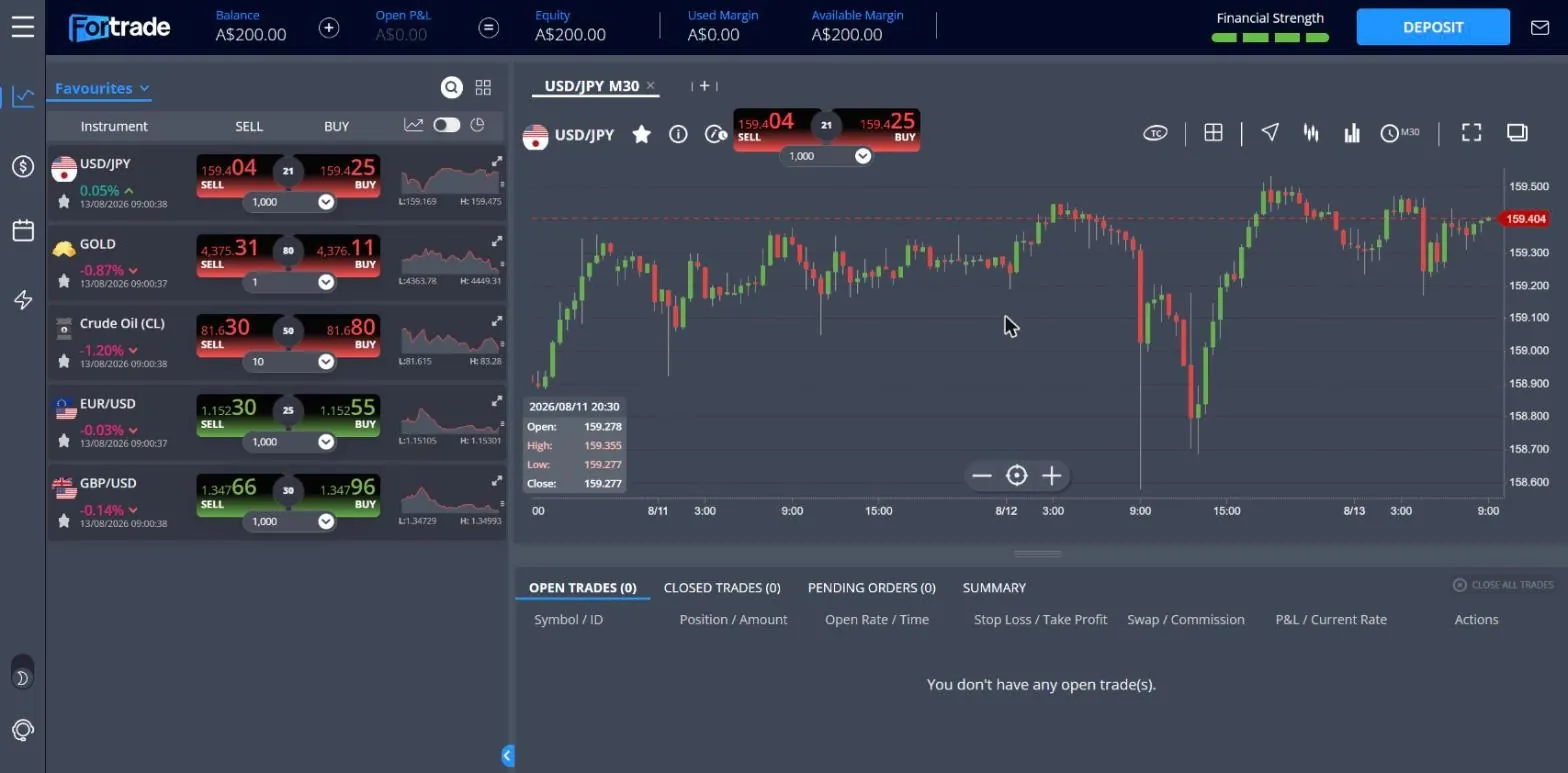
That is what turns this from a single odd reading into a result. The advertised figures describe the hours outside the window, they replicate to the decimal 24 hours apart, and the widening appears and disappears with the window on exactly the two instruments Fortrade publishes a night figure for.
Two limits, stated plainly. Our readings are spot checks rather than a continuous sample, so a currency pair could widen at a moment we were not watching, particularly around the 20:59 to 21:01 GMT rollover. And “min” is Fortrade’s own word for the commodity figures, so US$1.10 on gold is a floor for the window rather than a ceiling.
One last thing about the window, and it is the reason an Australian would never think to look. The platform localises time when it suits: the instrument panels state Premium Time as “06:59 (GMT +10:00)”, and the trading hours and holiday tables are headed “Quotes (GMT+10:00)” and “Trade (GMT+10:00)”. The one figure that widens a client’s cost is the one left in GMT, on a public web page, with no conversion offered. Nothing in the platform mentions a night spread at all: three instrument detail panels were opened and none of them refers to a widened window or a time-varying spread.
Fortrade leverage, margin and close-out
Fortrade holds Australian retail clients to the ASIC product intervention caps, and the way those caps interact with Fortrade’s own pair classification produces an advantage over the same brand’s British offering.
| Product | Maximum retail leverage | Initial margin |
|---|---|---|
| Major currency pair | 30:1 | 3.3% |
| Minor currency pair, gold, major index | 20:1 | 5% |
| Commodity other than gold, minor index | 10:1 | 10% |
| Share and ETF CFD | 5:1 | 20% |
| Crypto-asset | 2:1 | 50% |
All 21 pairs Fortrade classifies as majors run at 30:1 on the Australian entity. On the British entity, 14 of the same 21 run at 30:1 and seven run at 20:1. Six of those seven are Australian dollar pairs: AUD/USD, AUD/JPY, AUD/CAD, AUD/CHF, EUR/AUD and GBP/AUD. The reason for those six is regulatory rather than commercial, since ASIC’s product intervention order treats Australian dollar pairs as major currency pairs and the Financial Conduct Authority’s equivalent does not. Same broker, same software, same underlying instrument, two different caps.
The seventh is EUR/CAD, and the regulatory explanation does not cover it. Both currencies sit inside the Financial Conduct Authority’s own major list, so a British client should see 30:1 there and sees 20:1 instead, while an Australian client on the same instrument gets 30:1. That one looks like Fortrade’s own classification rather than either regulator’s. Note separately that AUD/NZD is classified Minor here and runs at 20:1 in Australia, which surprises local traders more often than it should.
We read those caps back off the platform on 13 August 2026 to confirm Fortrade applies them: the instrument panels put gold at 5% initial margin and 1:20, and both GBP/USD and USD/JPY at 3.33% and 1:30. The same published table carries a professional-trader column at 1:200 across the majors. That tier is not available to a retail client, and the caps in the table above are what an Australian retail account gets. The full framework is set out in ASIC’s CFD product intervention rules.
The close-out level Fortrade does not publish
ASIC requires a margin close-out at 50% of the minimum required margin, and Fortrade’s Australian account operates at that level. What Fortrade does not do is tell a client so anywhere they can read it before funding.
Looking for Fortrade's margin close-out level
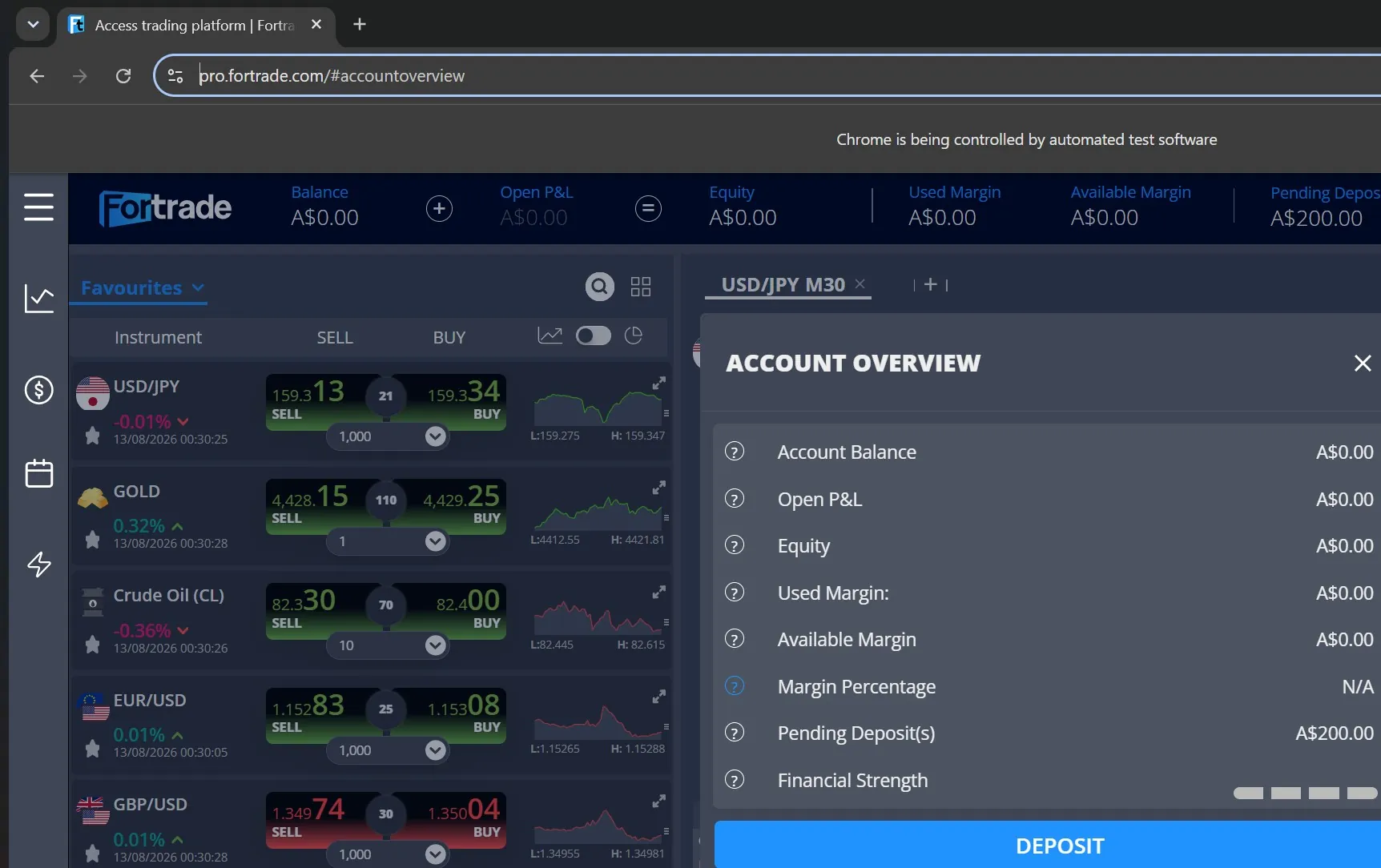
- Platform, Account Overview panel Exposes Balance, Open P&L, Equity, Used Margin, Available Margin and a Margin Percentage field, with the formula behind it. No close-out or stop-out percentage appears.
- Platform, main menu and Reports No margin policy, no close-out setting and no notification threshold is surfaced anywhere in the interface.
- Australian trading conditions page Publishes initial margin per instrument, from 3.3% on majors to 50% on crypto, and stops there. Initial margin is what opens a position, not what closes it.
- Where it stops ASIC mandates a 50% close-out for retail clients and it binds every Australian licensee, so that is the level a Fortrade client trades under. A client relying on Fortrade's own published material would never learn it.
Fortrade platforms: one proprietary platform, and an MT4 nobody mentions
Fortrade runs its own platform, Fortrader, as a web client and a mobile app. It is the only platform any Fortrade page, app listing or marketing asset refers to, in Australia or anywhere else, and the Australian platform carries no downloads menu entry at all.
MetaTrader 4 does exist here. The way that came to light is the point. On approving an Australian account, Fortrade sends an account-ready email reading “To login to MT4 and Fortrader, here are your account details”, with a single trading platform number covering both and one password shared across them. So MT4 is provisioned on funding and marketed to nobody.
That distinction matters for a prospective client rather than an existing one. Somebody comparing brokers before opening an account cannot know MT4 is available, because no page tells them, and a trader who needs MetaTrader will filter Fortrade out at the comparison stage on the broker’s own published information. The brokers that advertise the MetaTrader builds are listed in the MT4 platform comparison.
What Fortrade does not have in any form is cTrader, TradingView integration or depth-of-market pricing. Expert advisors are available through the MT4 credentials, not through anything Fortrade documents.
Is Fortrade safe? ASIC AFSL 493520
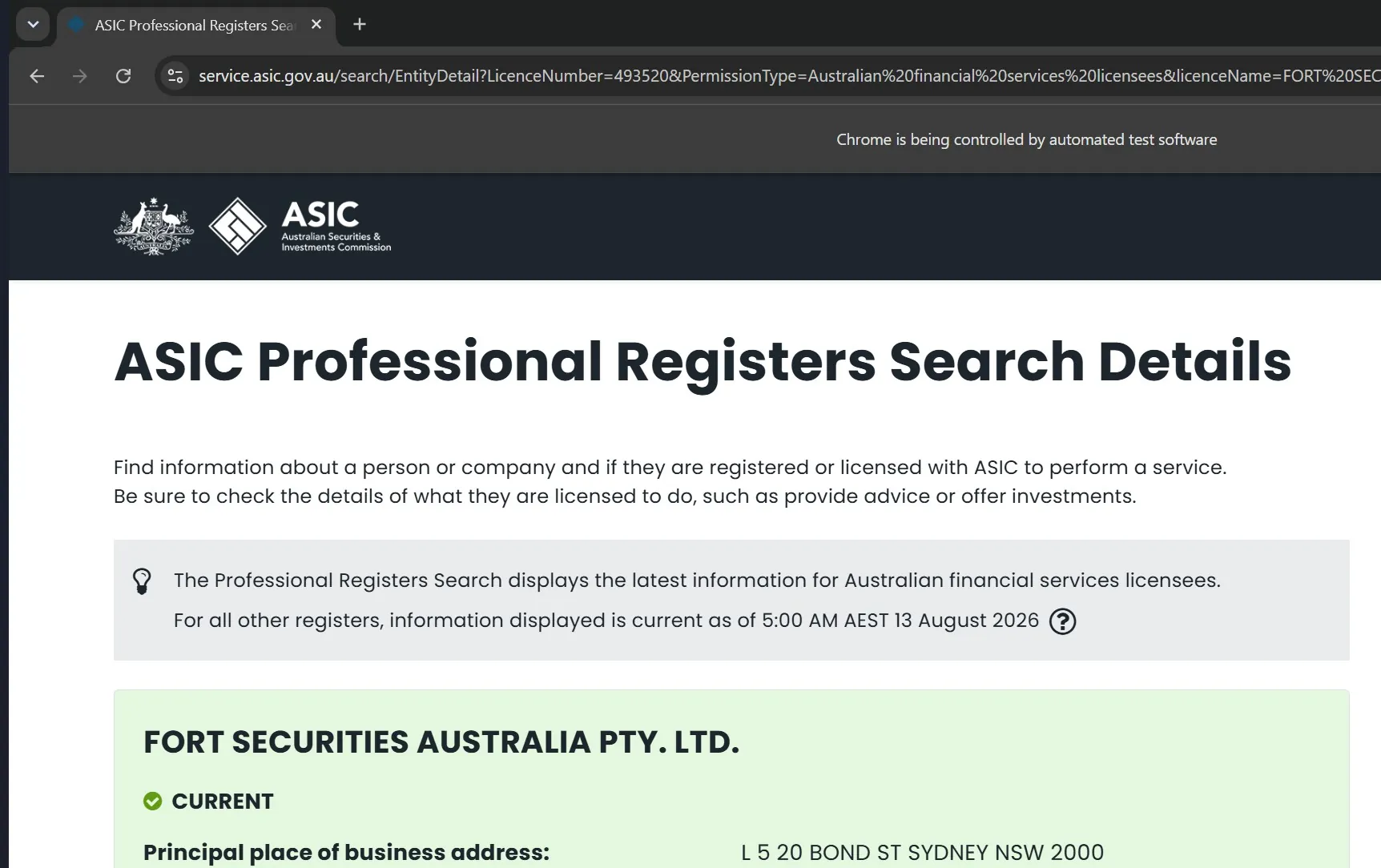
Fort Securities Australia Pty. Ltd. holds ASIC AFSL 493520, commenced 6 February 2019, under ABN 33 614 683 831 and ACN 614 683 831, from a registered address at Level 5, 20 Bond Street, Sydney NSW 2000. We checked the licence directly on ASIC’s professional registers on 13 August 2026: the record reads CURRENT. The entity is an AFCA member, holds client money in a segregated trust account under the Australian client money rules, and provides negative balance protection to retail clients.
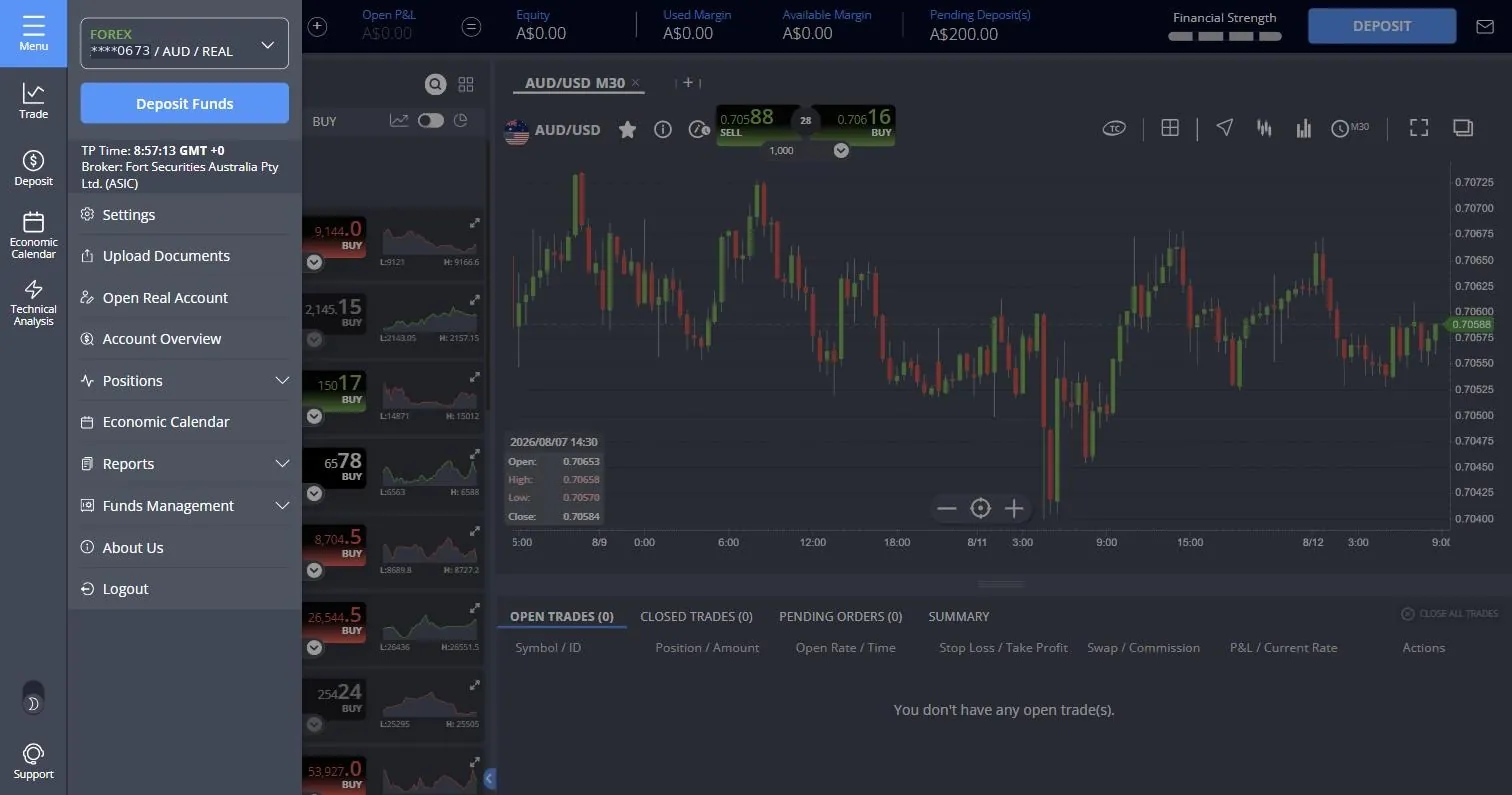
Naming the entity inside the platform is worth more than a footer disclosure, because it is what a client actually sees once inside.
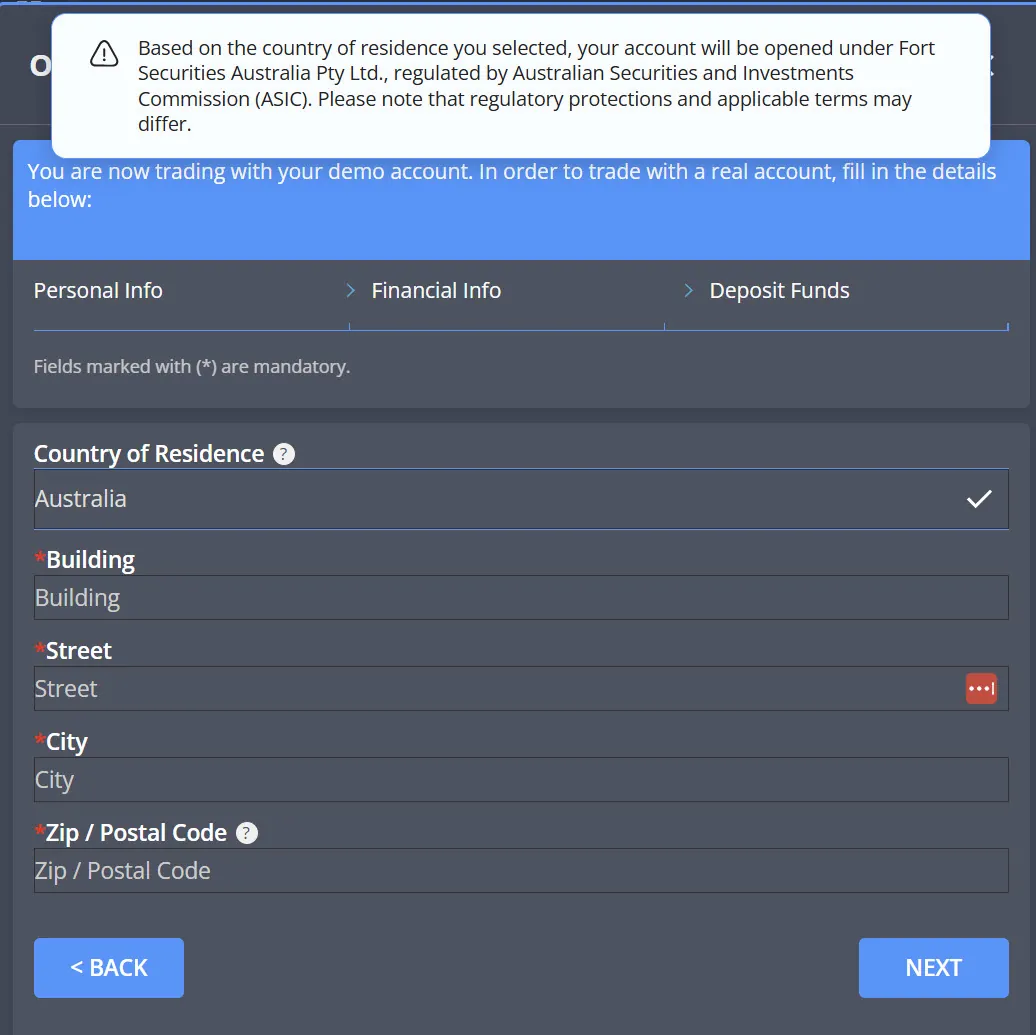
Entity assignment is also disclosed before an applicant reaches the address fields, driven by country of residence. An Australian applicant is told the account will be opened under Fort Securities Australia and regulated by ASIC, and a British applicant is told the equivalent about Fortrade Ltd and the Financial Conduct Authority.
Client money, and the interest on it
Client money sits in a segregated trust account under the Australian client money rules, per sections 7 and 8.9 of the Product Disclosure Statement dated 10 June 2025. Retail clients also get negative balance protection. The deposit screen shows that arrangement rather than merely asserting it: an Australian dollar wire is directed to an account with Westpac Banking Corporation, held in the name of Fort Securities Australia Client Money Trust Account. A named trust account at an Australian bank is the segregation the document describes, visible in practice.
One term in the same document deserves stating plainly, because clients rarely read that far. Fortrade retains all interest earned on client money. That is lawful and common enough, and it is also a real economic term: on a segregated balance held for months, the interest is the broker’s, not the client’s. The standard behind the protection is covered in negative balance protection on CFD accounts.
What has not been checked
One check on this entity has not been run, and it belongs on the page for that reason: no ASIC enforcement search has been run against Fort Securities Australia Pty. Ltd. The gap is reflected in the score.
What AFSL 493520 authorises
AFSL 493520 authorises Fort Securities Australia to provide general financial product advice, to deal by issuing and on behalf of another person, and to make a market, in derivatives and foreign exchange contracts, to retail and wholesale clients.
Market making is the authorisation that describes the business model. Fortrade is the counterparty to its clients’ positions rather than an agent routing them to a liquidity venue, which is a different arrangement from the raw-spread brokers that dominate the Australian market and is one reason the pricing looks the way it does. Clients wanting the agency model are compared in the ECN broker guide.
The licence runs to general advice only. Nothing Fortrade publishes or says to a client takes that client’s own objectives, financial situation or needs into account.
Fortrade markets: 329 instruments across eight classes
Fortrade offers Australian clients 329 CFD instruments, counted from the broker’s own Australian instrument table on 12 August 2026.
How Fortrade's 329 Australian CFDs divide by asset class
What the total hides matters more to an Australian than the total itself.
Nineteen of the 214 share CFDs are Australian, and they are the names a local trader would ask for first: Commonwealth Bank, ANZ, CSL, Macquarie, Coles, Aristocrat Leisure, National Australia Bank and The a2 Milk Company among them. The forex list of 50 splits into 21 majors, 7 minors and 22 exotics.
Metals are quoted in Australian dollars as well as US dollars, which is unusual and useful: XAU/AUD and Silver/AUD both appear alongside the US dollar contracts, so an Australian holding gold does not carry a currency leg on top of the metal.
Crypto is available here, and it is the clearest Australia versus Britain difference
Twelve crypto CFDs are available to Australian retail clients at the ASIC cap of 2:1, with Ether Futures the single exception at 1:1. Bitcoin, Ethereum, Solana, Ripple, Cardano, Dogecoin, Litecoin, Dash, Polygon, Bitcoin Cash and a micro bitcoin futures contract make up the rest.
British retail clients of the same brand get none of them. The Digital Currencies category is absent from the British instrument table entirely, because the Financial Conduct Authority has banned crypto derivatives for retail clients since January 2021. Any Fortrade review written for a British audience will say there is no crypto, and that statement does not carry to Australia. The asset class and its cap are covered in crypto CFDs and the 2:1 limit.
One caveat on the index and crypto pricing shown in-platform. Feed timestamps in our captures were not uniform: at 08:59 GMT, Canada 60 had last updated at 20:13 the previous evening and Hong Kong 50 at 08:13. Treat the quoted spreads on thinner instruments as indicative rather than continuously live.
Funding, withdrawals and the A$200 minimum
Fortrade opens an Australian account from A$200, and unlike several brokers on this site that figure is genuinely denominated in Australian dollars: the deposit screen inside the real account reads “Minimum deposit 200 AUD” against an A$ denominator.
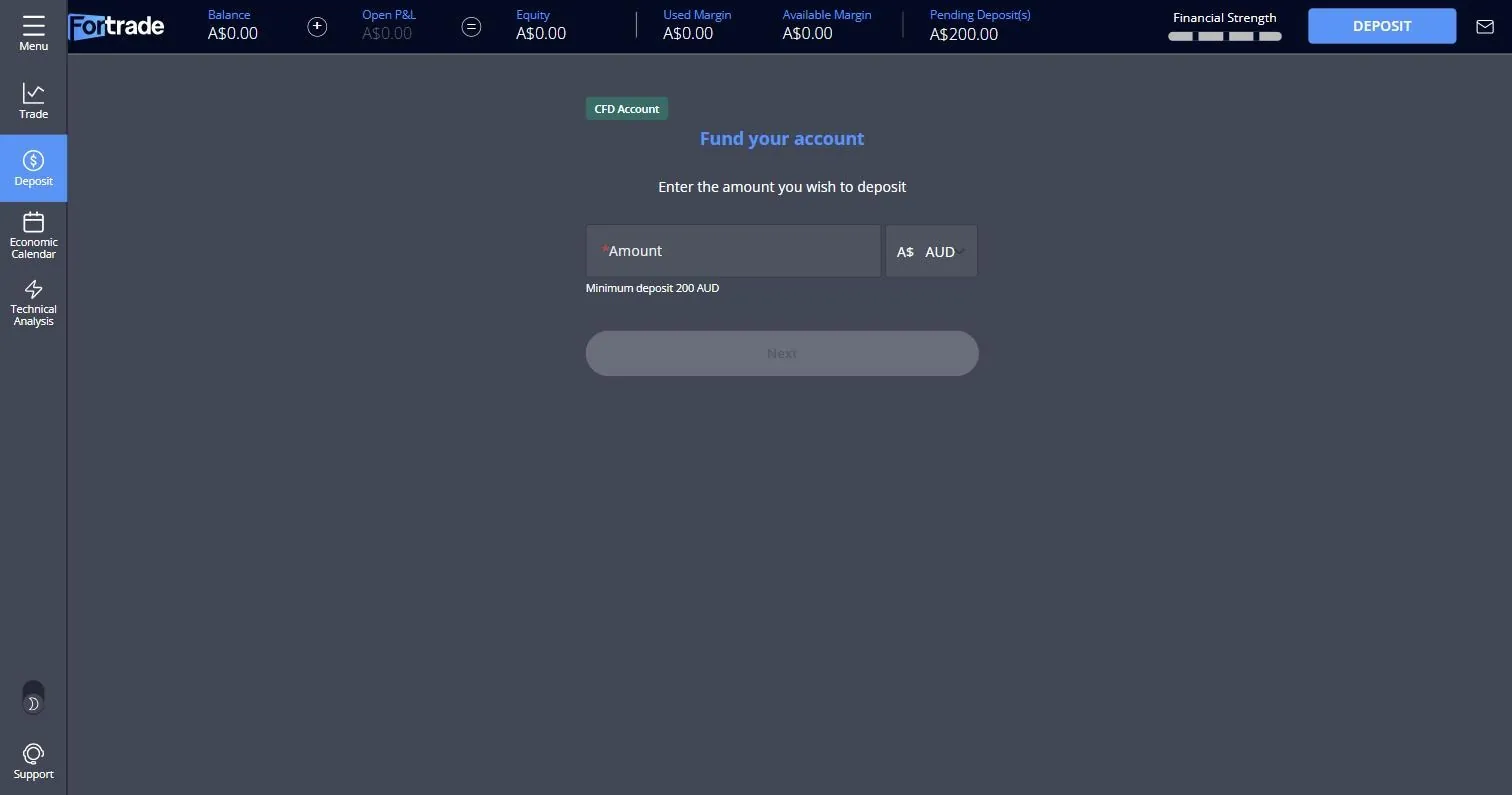
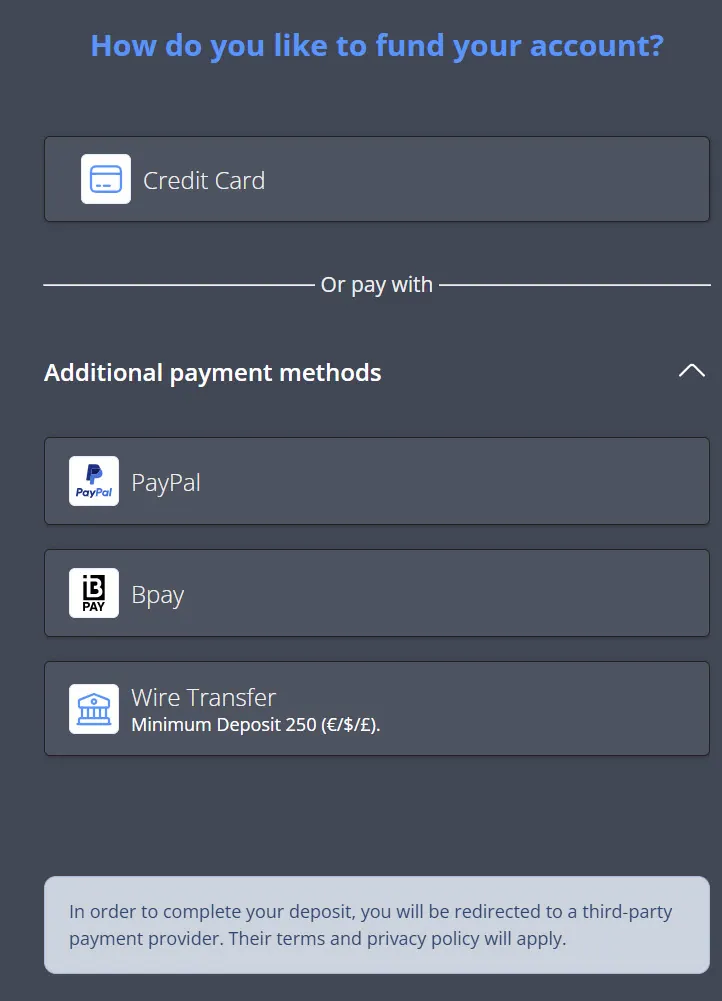
Deposits run through credit card, PayPal, BPAY and wire transfer. BPAY is the one that marks this as a local offering instead of a global product with an Australian wrapper on it, since it exists nowhere outside Australia.
Withdrawals go out by card, wire transfer, e-wallet and PayPal. What the withdrawal screen does not carry is any of the information a client needs to plan one.
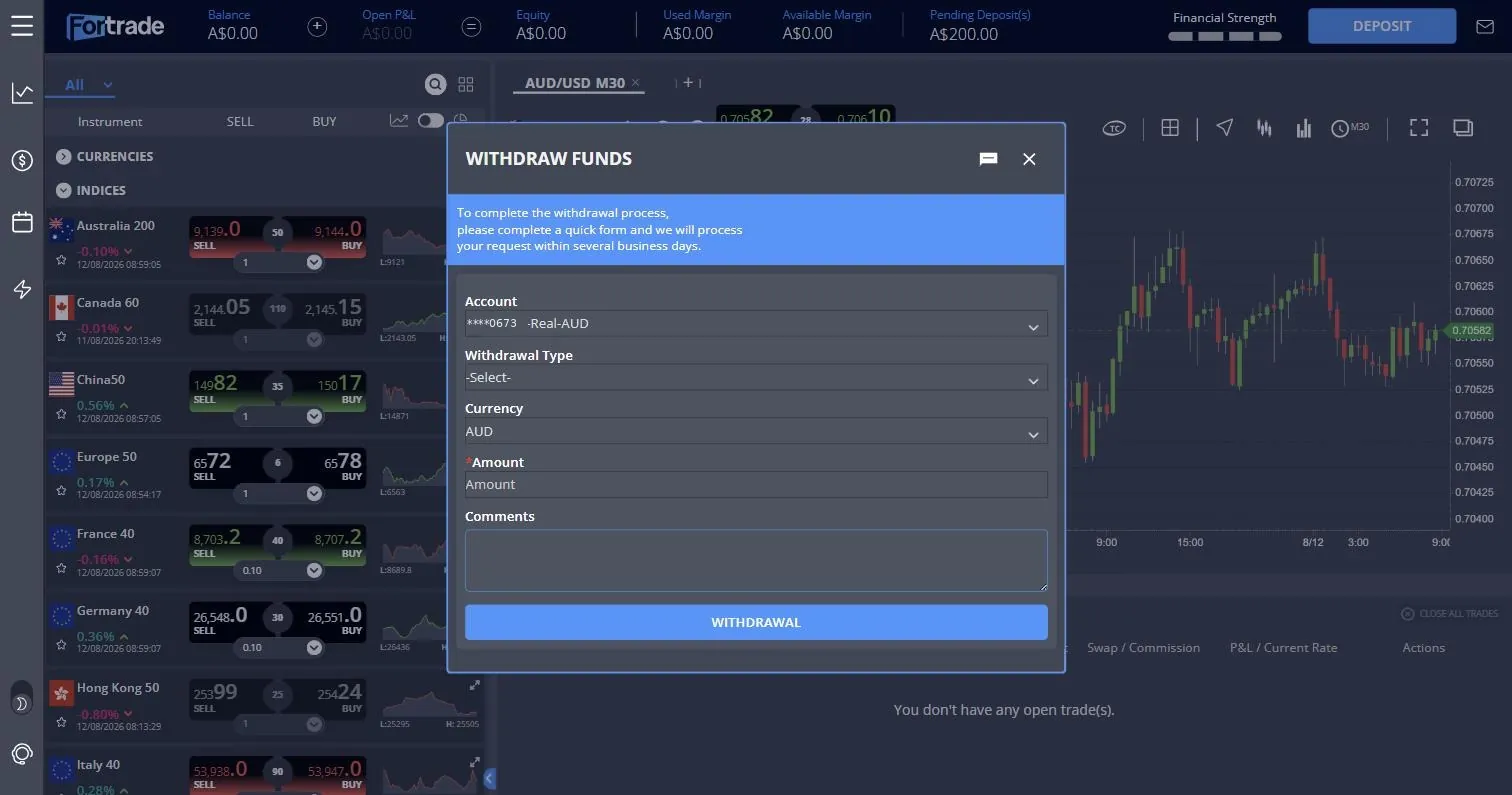
No fee is stated. No minimum is stated. No processing time is stated, with or without a withdrawal type selected, and the only timing language anywhere on the screen is a banner promising to process the request “within several business days”. A free-text comments box sits where a structured withdrawal form would normally be.
The deposit is the part we can time, and Fortrade’s own word for it is the problem. A$200 went in by PayPal on 12 August, and Fortrade emailed a receipt the same day confirming the amount, naming the currency as Australian Dollar, and promising that the money “is being processed and will appear in your account balance promptly”.
It did not. At 10:30 AEST the following morning the balance still read A$0.00 with A$200 pending. By 19:00 AEST on 13 August the balance read A$200.00, and the account history carried the deposit as a single line: transaction 1050310061, “Deposit Balance”, amount 200, timestamped 17:18. So “promptly” meant more than a day, on a payment rail that settles instantly at most brokers on this site.
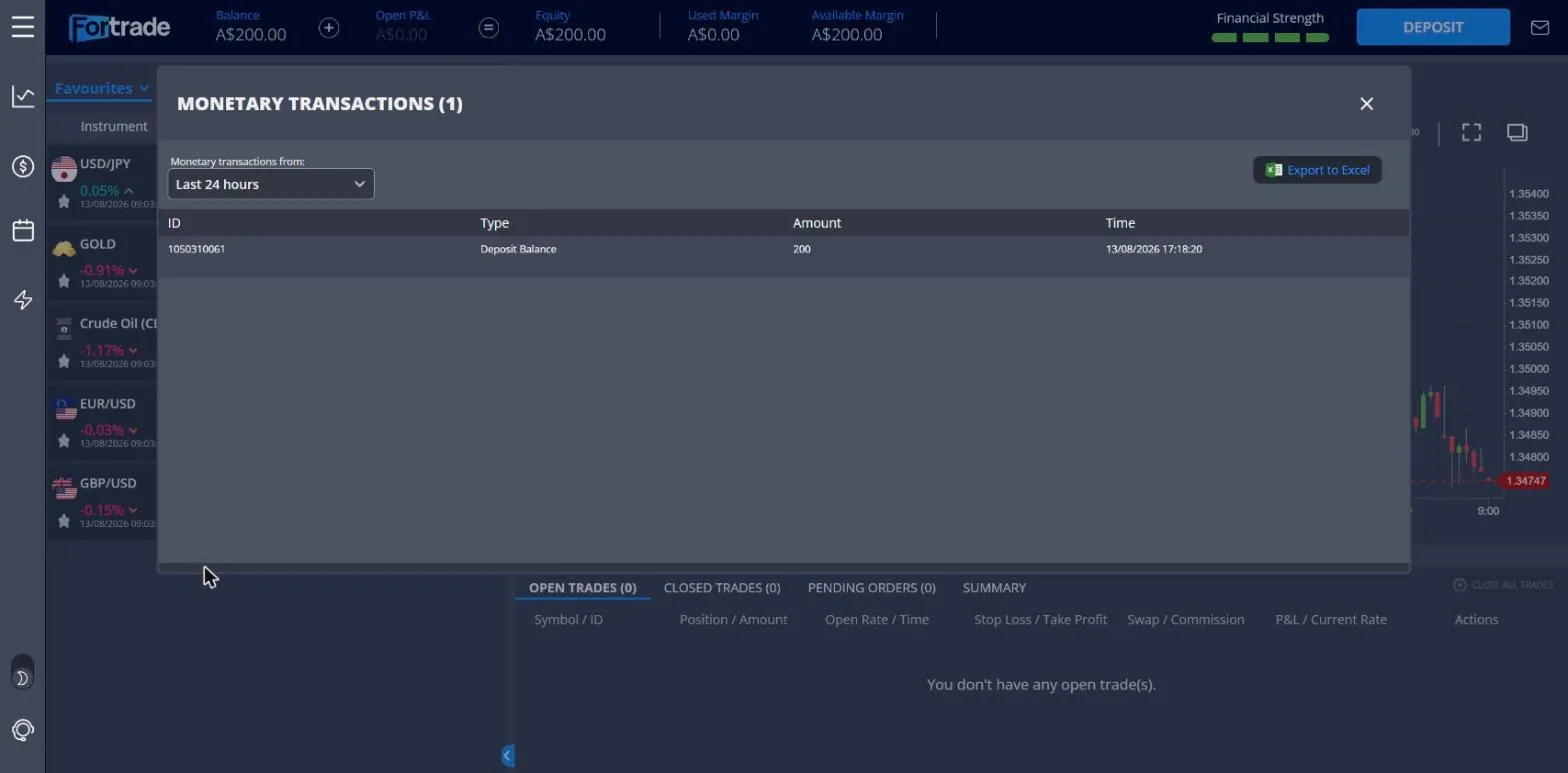
Withdrawal timing we still cannot give you. The request screen promises several business days and states no fee, no minimum and no processing time, and no withdrawal appears in the transaction history to measure against.
One funding figure is still not Australian. The wire transfer minimum is published as “250 (EUR/USD/GBP)” and is not denominated in Australian dollars anywhere, which leaves an Australian client to guess which of the three applies to them.
Fortrade asks to ring you, and asks again every six weeks
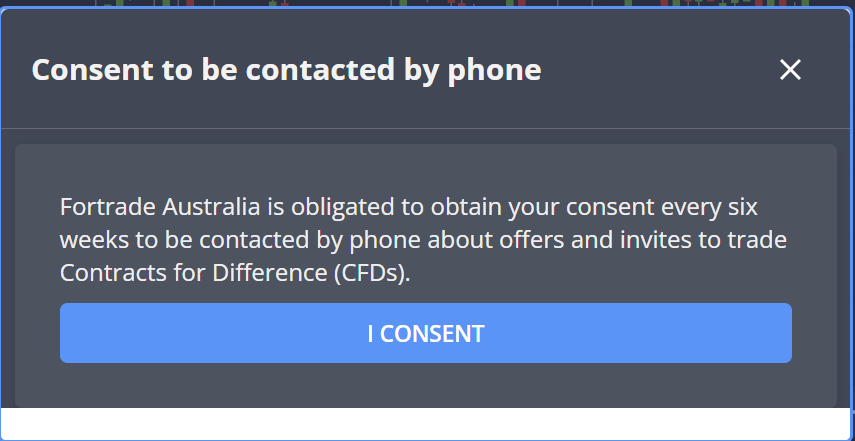
Logging in to the funded account on 13 August put a modal on the screen before any trading interface, at a route Fortrade names asicupdateacceptcalls. It reads, in full:
Consent to be contacted by phone
Fortrade Australia is obligated to obtain your consent every six weeks to be contacted by phone about offers and invites to trade Contracts for Difference (CFDs).
Three things about it are worth an Australian’s attention.
The cycle is short and it is the broker’s own number. Six weeks is not a figure we found in the Product Disclosure Statement, the target market determination or the Financial Services Guide reviewed for this page, and the modal offers no reference to the term it comes from. What it does tell a prospective client, plainly, is that being telephoned with offers to trade CFDs is a standing feature of holding an account here rather than a one-off at signup.
The control is one-sided. There is a button to consent and no button to decline, only a cross that closes the window. A client who wants to refuse has no recorded way to do it from that screen, and the modal returns.
And it explains the calls. Our own account was rung twice from a United Kingdom number late at night Australian time within hours of the deposit going in, described further down this page. A broker that re-asks for phone-contact consent on a six-week cycle is running an outbound calling operation, and the account we opened met it inside a day.
Dormancy, and a pattern of unlocalised figures
Fortrade publishes two different account dormancy triggers, in two current documents, and they differ by a factor of two.
| Source | Trigger | Fee |
|---|---|---|
| Australian trading conditions page, footnote 5, read 12 August 2026 | 6 months of inactivity | $10, EUR 10 or GBP 10 per month, depending on account currency |
| Australian Product Disclosure Statement, section 8.8, dated 10 June 2025 | 365 consecutive days without trading | Not stated in the same terms |
Both documents are current and both are published by the same entity for the same market. A client cannot tell from Fortrade’s own material whether an account goes dormant at six months or twelve.
The fee itself carries the second half of the problem, and it is part of a pattern rather than a one-off. Three separate published figures on Australian-facing surfaces are quoted in euros, US dollars and pounds with no Australian dollar equivalent, on an entity that offers and opens Australian dollar accounts:
- The wire transfer minimum, “250 (EUR/USD/GBP)”
- The dormancy fee, “$10, EUR 10 or GBP 10 per month depending on account currency”, where the account currency an Australian selects is not among the three listed
- Footnote 1’s daily swap example, given “in respect of 100 USD or EUR or GBP”, against a platform that states the actual unit amount for an FX major as 100,000
Those are three instances of the same thing, presented here without further comment because the reader can draw the conclusion. No Australian dollar dormancy figure appears in the platform either.
Opening an account: three steps and a mandatory assessment
Fortrade’s Australian application runs in three steps, and the entity a client contracts with is disclosed at the top of the flow, not buried in a document at the end of it.
A knowledge assessment is mandatory before a real account opens, per the Australian target market determination, version 6, dated 14 July 2025. Every applicant has to pass it. That determination also names retail clients as the target market and explicitly excludes wholesale clients, which sits oddly beside the professional-trader leverage column on the public pricing table but is what the document says.
The Australian disclosure set is complete and dated: a Product Disclosure Statement of 10 June 2025, the target market determination of 14 July 2025, a Financial Services Guide and the trading conditions pages. That Product Disclosure Statement settles the commission question, the client money treatment and the negative balance protection, and it is the first thing a prospective client should read here.
What happened when we opened one
Three steps is what the flow shows. It does not show what follows, and the rest of this section is a first-party record of that, taken from an Australian dollar account opened and verified on 12 August 2026.
Before applying we used Fortrade’s live chat to settle one question: does the Australian entity onboard retail clients. No answer came. The agent repeated that Fortrade holds an Australian Financial Services Licence and would go no further, which is a different statement from the one asked for. Fortrade’s own target market determination resolves it in a line, naming retail clients as the target market and excluding wholesale clients. A support desk that cannot state what its own published document states is a poor start.
Verification itself was unremarkable. A passport, then a utility bill, both uploaded through the portal, both standard at any Australian broker and required of them by law.
What came after the deposit was not unremarkable. Some hours after the A$200 was submitted by PayPal, late at night Australian time, the phone rang from a United Kingdom number. The caller was audibly in a busy room with other calls running behind him, and he asked for the email receipt PayPal issues against the transaction. We found it and sent it. Fifteen minutes later he rang back with a second request: proof that the money reaching PayPal had come from our own bank account. That one we refused.
Being exact about the complaint matters, because it is not the checks themselves. Australian licensees are obliged to verify identity and, where the risk calls for it, source of funds, and every broker on this site does both. The problem is the shape of this one. PayPal is a regulated payment provider that identifies its own account holders, the receipt already named the payer, and Fortrade had already taken the payment. Across every account this site has opened since 2014, no other broker has asked a client to document the bank transfer sitting behind a completed PayPal payment. The request was unreasonable, and we declined it.
That call carries a second finding, and it is the one an Australian should weigh hardest. A client in Australia, on an account issued under an Australian licence, was rung from a United Kingdom number, late at night in Australian hours, by somebody on what sounded like a shared floor. An AFSL is a licence, not a local operation. Fortrade holds the licence. On this evidence it does not run the operation.
How Fortrade compares to Mitrade and eToro
Fortrade sits 30th of the 32 ASIC-regulated brokers scored on this site, on 45 out of 100, between Mitrade on 42 and eToro on 50. All three are proprietary-platform brokers priced through the spread, which makes them the fair comparison, not the raw-account brokers at the top of the table.
Against Mitrade, Fortrade wins on breadth and loses on entry cost. Mitrade opens from A$100 against A$200 here, and its platform is the more polished of the two. Fortrade answers with 329 instruments against Mitrade’s narrower list, 19 Australian share CFDs, Australian dollar metal contracts and the MT4 credentials Mitrade cannot match in any form.
Against eToro the gap is wider and runs the other way. eToro brings copy trading, real share investing and a far larger client base, and its Australian account is dollar-denominated in US dollars, which costs Australians on every deposit. Fortrade’s Australian dollar account and BPAY funding are the answer to that, and its 12 crypto CFDs at 2:1 compare with eToro’s much longer crypto list.
| If you value… | Consider |
|---|---|
| Measured, published spreads | Pepperstone or IC Markets |
| MetaTrader, advertised and supported | Pepperstone or Eightcap |
| A low entry deposit on a proprietary platform | Mitrade |
| Copy trading and real shares | eToro |
| Australian dollar funding through BPAY on a spread-only account | Fortrade |
Should you open a Fortrade account?
A Fortrade account suits an Australian who wants Australian dollar funding, BPAY, crypto CFDs at the retail cap and a simple platform, and who is not going to trade often enough for a 2.5 pip spread to compound against them. Active traders and anyone who prices a broker on cost should look elsewhere.
The pricing earns one more mention outside the cons list, because it is the fact most likely to decide a close call. On a spread-only broker the advertised spread is the entire cost of trading, so there is no commission structure to offset it and no raw account to switch to. At 2.5 pips on EUR/USD, a trader doing ten standard lots a month pays roughly what a raw-account client pays in a quarter.
Two groups get real value here. Australians who want local funding rails and an Australian dollar account get both, with metals quoted in Australian dollars as a bonus that larger brokers do not offer. Traders who want crypto CFDs on an ASIC-licensed entity get 12 of them at 2:1.
Three groups should look past it. Cost-sensitive traders meet the widest headline spread on this site. Strategy traders find no advertised MetaTrader, no cTrader and no TradingView, and cannot know before funding that MT4 exists. Anyone who values disclosure meets three material gaps: no published close-out level, no withdrawal terms at the point of request, and two dormancy triggers that contradict each other. A fourth group should read the onboarding section above before funding anything, because the account servicing behind this licence is not run from Australia.
Fortrade scores 45 on the 2026 assessment. That figure rests on a real Australian dollar account, its published Australian documentation and its own instrument table. The night-spread capture the earlier version of this page was waiting on has since been taken, on 13 August 2026, and it did not move the score: a real widening on gold and crude oil sits against no observed widening on the three currency pairs, and the deposit position weakened rather than strengthened. Every broker on this site is ranked at the best forex brokers in Australia.
No affiliate arrangement is in place with Fortrade as at 12 August 2026, so no commission is earned on any click from this page. The site’s position on commercial arrangements is set out in the advertiser disclosure.
FAQs
Is Fortrade regulated in Australia?
What is the minimum deposit at Fortrade in Australia?
What documents does Fortrade ask for when you open an Australian account?
Does Fortrade charge commission?
What spread does Fortrade charge on EUR/USD?
Does Fortrade offer MetaTrader 4 or MetaTrader 5?
Can Australians trade crypto CFDs with Fortrade?
How long does a Fortrade withdrawal take?
Does Fortrade charge an inactivity fee?
Related pages
About the author

Justin co-founded CompareForexBrokers in 2014 and has traded forex since 1998. Based in Melbourne, he has tested every ASIC-regulated broker on this site personally and has written for Forbes, Kiplinger, Finance Magnates, the Australian Financial Review and The Age. He holds a Bachelor of Commerce (Honours) and a Master of Marketing from Monash University. Justin is the co-founder and CEO of CompareForexBrokers.